
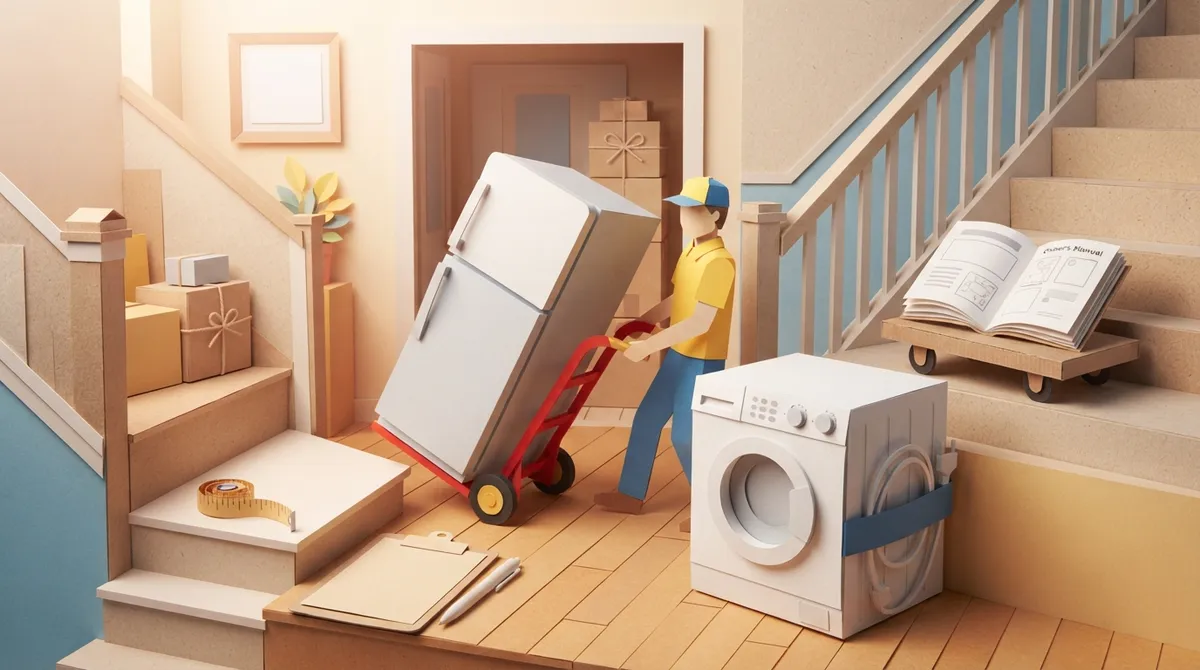
Key Takeaways
- Get a written scope of service before moving day, since many appliance movers transport and position units but leave gas, plumbing, or hardwired electrical disconnection to a licensed technician.
- Check the owner's manual first for model-specific transport steps, including shipping bolts for washers and whether a refrigerator can be tilted, since these instructions override general advice.
- Prepare each appliance: empty fridges and freezers, defrost and dry freezers, drain washer and dishwasher hoses, and tape down loose shelves, racks, and cords.
- Measure doorways, hallways, and stairwells at both homes, and tell your mover about stairs, elevators, parking limits, and HOA rules so the crew arrives equipped.
- Wait for the manufacturer's recommended time before plugging in a refrigerator after moving, since the required wait varies by model.
- Verify that movers are licensed and insured, get written estimates from several companies, and compare them, since choosing on price alone is a common mistake.
Let's be honest: nobody wakes up excited to haul a 250-pound refrigerator down a hallway. Appliances are heavy, bulky, and awkward. They also hide sharp edges, loose hoses, and cords that love to snag on door frames. One wrong turn and you could end up with a gouged floor, a dented door, or a sore back.
That's where appliance movers come in. These are moving professionals who transport big household equipment safely, using the right gear and the right know-how. Whether you're moving across Lakeland, shifting to a new place in Winter Haven, or heading out of state, this guide walks you through what appliance movers do, what they cost, and how to prepare. You'll also learn how to pick a team you can trust.
Think of this as a friendly chat with someone who has seen a lot of moving days. By the end, you'll feel ready to tackle yours with confidence.

What Do Appliance Movers Actually Do?
In the moving world, appliance movers transport large household appliances between homes or within a property. The most common items include:
- Refrigerators and freezers
- Washers and dryers
- Dishwashers
- Ranges, stoves, and ovens
- Microwaves and wine coolers
Professional crews usually bring appliance dollies, moving straps, protective blankets, and floor protection. The crew size and equipment depend on the appliance and the access conditions. A top-load washer in a ground-floor garage is a very different job than a French-door refrigerator in a third-floor condo.
The scale of the need is huge. The U.S. Energy Information Administration's 2024 Residential Energy Consumption Survey reports about 132.11 million U.S. homes using a refrigerator and about 112.99 million with a clothes washer (EIA Residential Energy Consumption Survey). In other words, almost every household has at least one of these heavy items to deal with when it's time to move.

Moving vs. Installing: Know the Difference
Here's a point that trips up lots of folks. Moving an appliance and installing an appliance are two different jobs.
Many movers will transport your appliance and set it in place. But disconnecting or reconnecting gas lines, water lines, or hardwired electrical connections often needs a qualified, licensed technician. This matters most for gas ranges and dryers, because a bad connection can create safety risks.
Always ask your mover a simple question: "What exactly is included?" Get the answer in writing. A clear scope keeps surprises off your moving day and out of your wallet.
How Much Do Appliance Movers Cost?
Pricing varies quite a bit, and no single number fits every move. A written estimate that spells out what's covered is your best friend here. Costs typically depend on:
- Appliance size and weight
- Stairs, narrow doorways, or tight hallways
- Distance traveled
- Parking and truck access
- Number of items
- Whether packing, disconnection, or other services are included
For a sense of ballpark figures, one on-demand moving provider's 2026 pricing page estimates charges from roughly $50 to $276 across its vehicle and crew options, based on a five-mile trip with 15 minutes of labor. A marketplace listing also gives a broad U.S. range of $70 to $180 for appliance moving. Treat these as loose reference points, not guarantees. Rates shift by city and provider.
| Cost Factor | How It Affects Your Quote |
|---|---|
| Appliance weight and size | Heavier or larger units may need more crew members |
| Stairs and tight access | Extra effort and time can raise labor charges |
| Distance | Longer trips mean more time and fuel |
| Number of items | More pieces mean more handling time |
| Added services | Packing or disconnection may be priced separately |
Want to understand the bigger pricing picture? Check out what factors determine moving company pricing in 2026 for a helpful breakdown.
How to Prepare Your Appliances for a Move
Preparation protects your appliances and makes the crew's job smoother. The golden rule is simple: check the owner's manual first. Manufacturers give model-specific moving instructions, and those beat any general advice.
Here's a friendly step-by-step routine that works for most households:
- Read the manual. Look for transport and shipping instructions for each appliance.
- Empty everything. Take food out of the fridge and freezer. Remove dishes from the dishwasher and clothes from the washer and dryer.
- Clean and dry. Wipe down the interior of the refrigerator. Defrost freezers when needed and let them dry fully to avoid mold and odors.
- Drain hoses. Drain washer and dishwasher hoses so water doesn't leak during transport.
- Secure loose parts. Tape down or remove shelves, trays, racks, and cords so nothing rattles or breaks.
- Measure everything. Check doorways, hallways, and stairwells at both homes. A quick tape measure now saves a big headache later.
- Arrange qualified help. Book a licensed technician for gas, plumbing, or complex electrical work.
Refrigerator Tips
Refrigerators are usually best moved upright. If a unit must be tilted or laid down, follow the manufacturer's instructions for transport. Those same instructions will tell you how long to wait before plugging it back in. There is no single wait time that works for every model, so don't rely on a rule of thumb you heard from a neighbor.
Also secure the doors with tape or straps so they don't swing open mid-move. Take extra care with ice makers and water lines.
Washer and Dryer Tips
For washers, check the manual for shipping bolts or transit locks. If your model calls for them and you still have them, install them before the move. They keep the drum steady and protect the internal parts.
Disconnecting water or gas lines can cause leaks or safety hazards. Don't assume every moving crew is equipped or authorized to handle that work. Ask first, and plan for a technician if needed.
Why Hire Professionals Instead of Going DIY?
We totally get the urge to save money by rounding up a few friends and a pickup truck. Sometimes that works fine. But appliances are a different animal than couches and boxes.
- Safety: Heavy lifting causes real injuries. Pros use proper techniques and equipment.
- Protection: Blankets, straps, and floor guards protect both the appliance and your home.
- Efficiency: An experienced crew can navigate stairs and tight turns without trial and error.
- Peace of mind: Insured movers add a layer of financial protection if something goes wrong.
If you're still weighing it, our guide on hiring vs. DIY for a Polk County residential move lays out the pros and cons clearly. And for tips on lifting safely, see heavy lifting moving tips.
What About Stairs and Tricky Access?
This is one of the most common questions we hear, and the answer is yes: experienced crews can take appliances up and down stairs. But it takes planning, the right equipment, and often extra hands.
Tell your mover about every challenge before moving day:
- Stairs, including how many flights
- Narrow doorways or tight corners
- Elevators in apartments or condos
- Long walking distances from the truck
- Limited parking or HOA restrictions
Luxury apartment residents especially should mention elevator reservations and building rules ahead of time. Many properties require move-in windows and proof of insurance. If you're moving into an apartment, our apartment movers guide for Polk County can help you plan.
How to Find Insured Appliance Movers You Can Trust
A great mover makes the whole process feel easier. A questionable one can turn a simple job into a stressful mess. Here's a quick checklist to help you choose wisely:
- Verify licensing and insurance. Ask for proof, and don't be shy about it. Learn the signs in 9 ways to spot licensed and insured movers in Polk County.
- Get a written estimate. It should list the appliances, services, and any possible extra charges.
- Ask about experience. Have they handled your specific type of appliance, such as a built-in or side-by-side refrigerator?
- Clarify the scope. Confirm whether disconnection and reconnection are included or excluded.
- Read recent reviews. Look for comments about care, punctuality, and communication.
- Compare more than one quote. Prices and services can differ widely.
For a deeper dive, how to choose insured movers you can actually trust is a great read before you book. You can also learn what to expect from a free moving estimate, so you know the right questions to ask.
Appliance Moving for Different Types of Movers
Every household has its own needs. Here's how appliance moving looks for a few common situations.
Local Homeowners and Large Families
If you're moving across town in Polk County, you may have a full kitchen and laundry room worth of appliances. Bigger homes often have bigger, heavier models and more of them. A crew with extra labor can make short work of a long list.
Retirees and Seniors
Moving into a retirement home or downsizing often means deciding which appliances come along. Patience and careful heavy lifting matter most here. You shouldn't have to wrestle a washer or dryer yourself. Our article on senior moving services in Polk County shares more ways to make the transition gentler.
Luxury Homes and Apartments
High-end appliances such as professional-grade ranges, built-in refrigerators, and wine coolers deserve extra protection. Pricey finishes scratch easily. Look for movers who use floor runners, corner guards, and padded wraps, and who communicate clearly with building management.
Long-Distance Movers
For a bigger move, think about whether an older appliance is worth shipping. Sometimes it makes more sense to sell it and buy new at your destination. If you're keeping it, plan extra time for the appliance to settle before use, following the manufacturer's guidance. For more on planning farther moves, see what you should know before a long-distance move.
Common Mistakes to Avoid
Even careful folks slip up. Watch out for these frequent missteps:
- Skipping the owner's manual and guessing at transport steps
- Forgetting to measure doorways and hallways
- Assuming the movers will disconnect gas or water lines
- Plugging in a refrigerator right away after moving
- Choosing a mover on price alone without checking insurance
- Leaving water in hoses and creating a mess in the truck
Want more ways to dodge trouble? Browse 14 mistakes to avoid when hiring local residential movers in Polk County, FL for extra guidance.
Where DynaMight Movers Fits In
At DynaMight Movers, we handle the heavy stuff so you don't have to. We're a licensed and insured residential moving company serving Lakeland, Winter Haven, Davenport, Dover, and the rest of Polk County. Our crews bring the strength, the equipment, and the care that bulky appliances demand.
We believe in transparent pricing, which means your estimate is your price, with no surprises on moving day. If you'd like to see what neighbors say, visit us on Google and read DynaMight Movers reviews. And if you're curious about the full process, our guide on how to hire appliance movers in Lakeland, Florida goes even deeper.
Wrapping It Up
Appliances don't have to be the scary part of your move. With the right preparation, a clear written scope, and a trusted team, moving a refrigerator, washer, or range can be smooth and stress-free. Remember to check your manuals, plan for qualified technicians when gas or plumbing is involved, and always confirm that your movers are licensed and insured.
Ready to hand off the heavy lifting? Get a free estimate from our friendly team today, or call us at (866) 349-7719 to talk through your move. We'd love to help you settle into your new space with every appliance safe, sound, and ready to go.
FAQs
Q: What do appliance movers move?
A: Appliance movers handle big household items like refrigerators, freezers, washers, dryers, dishwashers, ranges, and ovens. They use dollies, straps, and protective blankets to get them from point A to point B safely.
Q: Do appliance movers disconnect and reconnect appliances?
A: It depends on the company, so always ask. Many movers transport and position appliances but leave gas, plumbing, and hardwired electrical work to a licensed technician for safety. Get the scope of service in writing before moving day.
Q: Can a refrigerator be transported on its side?
A: Upright is usually best, but some units can be tilted or laid down if the manufacturer allows it. Check your owner's manual for transport steps and how long to wait before plugging it back in, since the wait time varies by model.
Q: Do washers need shipping bolts when moved?
A: Many washers do. Check your manual, and if your model calls for shipping bolts and you still have them, install them before the move to protect the drum and internal parts. Not every model uses them, so the manual is your best guide.